



Donna Sicuranza is best known for her long connection with animal welfare in Connecticut and her leadership work with Tait’s Every Animal Matters, commonly known as TEAM. Her public professional identity is closely connected to the organization’s mobile feline spay, neuter, and vaccination program.
The most important reason people search for Donna Sicuranza is her work addressing feline overpopulation. Rather than focusing only on animal rescue after a problem develops, TEAM has traditionally emphasized prevention. Its mobile clinic brings veterinary services to communities and helps cat owners and caretakers access spay, neuter, and vaccination services.
Historical reporting from Connecticut newspapers identifies Sicuranza as a spokesperson and coordinator associated with TEAM during the organization’s early years. In 2001, she explained that the mobile unit was particularly useful for rural communities with barn cats and feral cat colonies. At that time, TEAM reported having sterilized more than 40,000 cats since its launch in 1997.
More recent public information connects Donna Sicuranza, also listed in some TEAM materials as Donna Sicuranza Marconi, with the organization’s executive leadership. TEAM’s current public information is reported to place its work in Westbrook, Connecticut, with a continuing focus on feline population management.
This article explains who Donna Sicuranza is in the public record, what the TEAM Mobile Feline Unit does, why feline overpopulation is difficult to solve, and why mobile veterinary care can make a difference. It also separates documented information from claims that are difficult to verify online.
Who Is Donna Sicuranza?
Donna Sicuranza is an animal-welfare and nonprofit professional whose public career is strongly associated with Tait’s Every Animal Matters.
She is not primarily known as a celebrity, entertainment personality, or public figure in the traditional sense. Her name is mainly associated with nonprofit work, veterinary access, cat welfare, and efforts to reduce the number of unwanted and free-roaming cats.
Some recent public references use the name Donna Sicuranza Marconi. Older TEAM materials and historical news reports use Donna Sicuranza or Donna J. Sicuranza. Public records connecting these names to TEAM indicate that they refer to the same animal-welfare professional rather than unrelated people. A 2019 TEAM publication, for example, lists Donna J. Sicuranza among the organization’s supporters.
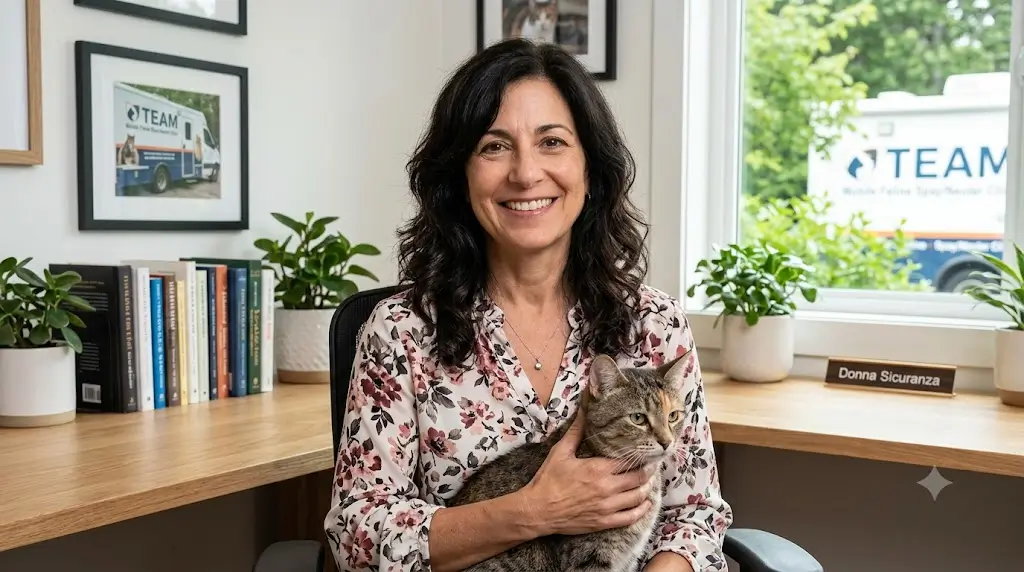
It is important to be careful when researching a person with a relatively common name. Search engines can combine information about different individuals. In this case, other people named Donna Sicuranza appear in unrelated records, including a Donna Marie Sicuranza associated with the banking industry in New York.
Those individuals should not automatically be treated as the same person.
For an accurate Donna Sicuranza biography, the strongest connection is the documented professional relationship with Tait’s Every Animal Matters and its feline welfare mission.
What Is Tait’s Every Animal Matters?
Tait’s Every Animal Matters, usually shortened to TEAM, is a Connecticut nonprofit organization focused on animal welfare.
One of its most recognizable programs is the TEAM Mobile Feline Unit. The program was created to provide spay, neuter, and vaccination services to cats through a mobile veterinary setting.
The concept is simple.
Instead of requiring every cat caretaker to travel to a traditional veterinary hospital, a mobile clinic can travel to different communities. This can make basic veterinary services easier to reach, especially for people dealing with transportation problems, financial limitations, rural locations, or large groups of outdoor cats.
Also Read: Global Active Device: The High-Availability Storage and Disaster Recovery
Historical records describe TEAM as operating a mobile feline clinic throughout Connecticut. A guide to mobile spay and neuter clinics published by the North Shore Animal League America lists the TEAM Mobile Feline Unit as a Connecticut program serving both domestic and feral cats. The guide records the mobile program’s startup date as March 1, 1997.
The organization has therefore been involved in feline population management for decades rather than being a new online initiative.
Donna Sicuranza and the TEAM Mobile Feline Unit
The connection between Donna Sicuranza and the TEAM Mobile Feline Unit goes back to the program’s early years.
A 2001 report from The Middletown Press identified Sicuranza as a TEAM spokesperson. The report described the mobile clinic’s work in Durham, Connecticut, where the unit provided affordable spay, neuter, and vaccination services. It also noted that the clinic performed an average of about 40 surgeries during a visit.
This historical information is useful because it shows that Sicuranza’s involvement was not a recent development created by social media or modern search trends.
Her public connection with TEAM existed decades ago.
The early mobile clinic was designed around a practical problem: many cats were not receiving preventive veterinary care, particularly cats living outdoors or in colonies.
The program’s basic philosophy was that preventing unwanted births could reduce the number of cats entering shelters, living without adequate care, or being exposed to dangerous conditions.
This is why Donna Sicuranza is frequently associated with the phrase “ending feline overpopulation.”
What Does the TEAM Mobile Feline Unit Do?
The TEAM mobile clinic focuses on several important veterinary services for cats.
These services have historically included:
- Spaying female cats
- Neutering male cats
- Vaccinations
- Basic examinations
- Nail trimming
- Treatment for certain minor conditions
- Services for domestic cats
- Services for feral and community cats
Historical reports show that TEAM bundled several services together at an affordable price. In 2001, the reported fee was $39 and included spay or neuter surgery, an examination, vaccinations, nail trimming, and treatment for ear mites when needed.
That historical price should not be confused with today’s pricing.
Veterinary costs change over time because of inflation, medication costs, staffing, equipment, insurance, and other operating expenses. People looking for current TEAM services should check the organization’s current information rather than relying on old newspaper articles.
A Connecticut animal-welfare resource currently lists TEAM as a mobile spay, neuter, and vaccination clinic and advises people to contact the organization for scheduling and appointments.
Why Feline Overpopulation Is a Serious Problem
Feline overpopulation can be difficult for communities to manage because cats can reproduce quickly.
When unsterilized cats live outdoors, a small number of animals can eventually become a much larger colony. Kittens may be born without reliable access to food, shelter, veterinary care, or human protection.
Some cats enter shelters.
Others remain outdoors.
Some become community cats cared for by local residents.
Others may be abandoned, lost, or surrendered by owners who cannot continue caring for them.
This creates pressure on animal shelters, rescue groups, municipal animal-control agencies, veterinary organizations, and individual volunteers.
The problem is therefore larger than simply counting cats.
It involves animal health, household finances, shelter capacity, community resources, and responsible pet ownership.
Spaying and neutering are important because they address the problem before unwanted kittens are born.
Why Spaying and Neutering Matter
Spaying and neutering are among the most common methods used to reduce unwanted cat births.
A spay procedure prevents a female cat from becoming pregnant. Neutering prevents a male cat from reproducing.
For communities dealing with free-roaming cats, sterilization can be especially important because caretakers may have limited ability to determine which cats are reproducing.
A mobile program can make this process more practical.
Instead of asking every caretaker to find a private veterinary appointment, the program can establish a location and schedule where multiple cats are treated.
That efficiency is one reason mobile spay and neuter programs have become part of the animal-welfare system in many parts of the United States.
Donna Sicuranza and Feral Cat Welfare
One of the most important aspects of TEAM’s work is its attention to feral and community cats.
A feral cat is generally a cat that has little or no positive socialization with humans and may avoid close human contact. A community cat can be a broader term for outdoor cats that may be feral, stray, or loosely connected to people in a neighborhood.
These categories are not always easy to determine.
A frightened stray cat can behave like a feral cat.
A socialized cat may become fearful after being lost outdoors.
A community cat may have several people feeding it.
For that reason, responsible cat-welfare programs need to consider the animal’s behavior and circumstances rather than assuming every outdoor cat is homeless.
Historical reporting shows that a significant portion of TEAM’s clients included cats from feral colonies. In 2001, the organization said about one-third of the cats it had treated came from feral colonies.
This illustrates an important point about Donna Sicuranza’s work: the program was not designed only for traditional household pets.
It also addressed cats living outside human homes.
What Is Trap-Neuter-Return?
Trap-neuter-return, commonly called TNR, is an approach used to manage community and feral cat populations.
The basic process involves safely trapping an outdoor cat, transporting the animal to a veterinary provider, having the cat sterilized and vaccinated as appropriate, and returning the cat to its established environment.
The goal is population management through sterilization rather than allowing uncontrolled reproduction.
TNR also requires responsible human involvement.
Caretakers may need to provide appropriate food, monitor the cats, watch for illness or injury, and help identify new unsterilized animals entering a colony.
TNR is therefore more than simply catching a cat and releasing it.
It is a community-management strategy.
TEAM’s historical materials and reporting show that the organization has supported services for feral cats. An older Animal People report described a rebate program designed to encourage caretakers to bring feral cats to the mobile clinic for sterilization.
How Mobile Veterinary Clinics Help Communities
Mobile veterinary clinics can solve an access problem.
A traditional veterinary hospital may provide a wide range of services, including diagnostics, surgery, dentistry, emergency care, imaging, and long-term treatment.
A specialized mobile clinic can focus on a smaller number of high-demand services.
That specialization can improve efficiency.
For example, a clinic focused mainly on spay, neuter, and vaccination services can organize its workflow around those procedures rather than maintaining all the equipment and staffing required by a full-service hospital.
This does not mean mobile clinics replace regular veterinarians.
They serve different purposes.
A cat may receive a spay or neuter procedure through a specialized program and still need a regular veterinarian for dental care, chronic illness, diagnostic testing, injuries, nutrition concerns, or other medical needs.
That distinction is important for responsible pet care.
Donna Sicuranza’s Leadership Role
The work of a nonprofit executive is broader than the medical procedure itself.
Veterinarians perform medical procedures.
But a nonprofit program also needs administration, scheduling, communication, fundraising, community partnerships, volunteers, financial management, public education, and long-term planning.
Donna Sicuranza’s professional connection with TEAM illustrates this broader side of animal welfare.
The success of a mobile veterinary program depends on people knowing when the clinic will arrive, understanding which cats qualify, preparing animals for surgery, transporting them safely, completing required paperwork, and following postoperative instructions.
A program must also maintain public trust.
People need confidence that the organization is legitimate, that veterinary procedures are performed appropriately, and that donations and resources support the stated mission.
This is where nonprofit leadership becomes especially important.
The Historical Growth of TEAM
TEAM’s history provides useful context for understanding Donna Sicuranza’s work.
When the program began in 1997, mobile spay and neuter clinics were less common than they are today.
A 2000 report stated that TEAM had already spayed or neutered more than 35,000 cats after being established in 1997.
By 2001, another report placed the total above 40,000 cats.
A Connecticut Department of Agriculture publication later described Dr. John A. Caltabiano as the veterinarian who launched the TEAM Mobile Feline Unit in 1997 while serving as president of Tait’s Every Animal Matters. The publication also noted that Donna Sicuranza was his longtime partner and that she would continue his work with TEAM after his death in 2009.
These historical records demonstrate that TEAM’s impact accumulated over many years.
Donna Sicuranza and Dr. John A. Caltabiano
Dr. John A. Caltabiano is an important part of the history surrounding Donna Sicuranza and TEAM.
Caltabiano was a veterinarian known for mobile veterinary medicine. According to the Connecticut Department of Agriculture, he established a mobile veterinary medical clinic in 1980 and later launched the TEAM Mobile Feline Unit in 1997.
His approach was based on bringing veterinary care closer to the animals and people who needed it.
That philosophy became especially useful for feline population management.
Caltabiano died in 2009. His obituary states that he was survived by his longtime partner, Donna Sicuranza, and that she would continue his work at TEAM.
This history should be presented carefully.
TEAM’s accomplishments were not created by one individual alone. Veterinarians, technicians, administrative staff, volunteers, donors, community partners, and cat caretakers all contribute to the results of a large animal-welfare program.
Donna Sicuranza’s role is best understood as part of that larger team.
How Many Cats Has TEAM Helped?
The number of cats served by TEAM has increased substantially since the program began.
Historical sources provide several milestones.
In 2000, TEAM was reported to have spayed and neutered more than 35,000 cats.
In 2001, reports said the organization had sterilized more than 40,000 cats.
A 2010 Connecticut Department of Agriculture publication reported that TEAM had sterilized more than 128,000 cats by the time of Caltabiano’s death.
More recent public descriptions of TEAM report that its veterinarians have sterilized and vaccinated more than 225,000 cats since 1997. Because this is an organizational figure rather than a statistic independently audited in the sources reviewed for this article, it is best described as a figure reported by TEAM rather than an independently verified national statistic.
The broader lesson is still significant.
A program that operates for almost three decades can produce a large cumulative effect even when each individual appointment seems small.
Why Affordable Veterinary Care Matters
Cost is one of the major barriers to veterinary care in the United States.
Many pet owners want to provide excellent medical care but may struggle when several expenses occur at the same time.
Spay or neuter surgery can be an important preventive service, but the cost can still be difficult for some households.
Mobile nonprofit programs can help fill this gap.
The value is not limited to the person receiving a lower-cost service.
Preventing unwanted litters can reduce future pressure on shelters and rescue organizations.
That means affordable preventive care can have effects beyond the individual animal.
This is one of the strongest ideas behind the TEAM model.
The Difference Between a Mobile Clinic and a Full-Service Veterinarian
People searching for Donna Sicuranza or TEAM should understand that a specialized mobile clinic is not necessarily a substitute for a primary veterinarian.
A full-service veterinarian may handle:
- Routine wellness examinations
- Chronic diseases
- Dental care
- Diagnostic testing
- Blood work
- Imaging
- Emergency treatment
- Injuries
- Prescription medications
- Senior-pet health
- Long-term medical monitoring
A specialized spay and neuter clinic may focus on a narrower group of services.
This distinction is important because sterilization is only one part of a cat’s overall health.
Responsible owners should maintain an ongoing relationship with a veterinary professional when possible.
Donna Sicuranza and Responsible Pet Ownership
The work associated with Donna Sicuranza also connects with a larger concept: responsible pet ownership.
Responsible cat care includes more than feeding an animal.
It can involve:
- Providing safe shelter
- Obtaining appropriate veterinary care
- Vaccinating when recommended
- Sterilizing cats when appropriate
- Keeping identification information current
- Preventing accidental breeding
- Monitoring changes in behavior or health
- Planning for long-term expenses
- Avoiding abandonment
For outdoor cats, responsible care may require additional planning.
Caretakers should understand local laws and neighborhood rules, work with animal-welfare professionals when necessary, and make sure that cats are not being mistaken for lost or owned pets.
Why Feline Overpopulation Cannot Be Solved by One Organization
It is tempting to look for one person or one organization that can “end feline overpopulation.”
In reality, the problem is much more complex.
It involves pet owners, breeders, shelters, veterinarians, animal-control agencies, rescue groups, local governments, donors, volunteers, and community members.
Spay and neuter programs are one part of the solution.
Other parts include adoption, fostering, identification, reunification of lost pets, public education, responsible breeding practices, shelter medicine, and support for low-income pet owners.
Donna Sicuranza’s work is therefore best viewed as one part of a broader animal-welfare system.
The most useful insight is not that one person can solve the entire problem.
It is that sustained programs can make measurable progress when prevention, veterinary care, community education, and public participation work together.
What Makes the TEAM Model Different?
The TEAM model has several characteristics that help explain its long history.
First, it is specialized.
The organization concentrates heavily on feline population management rather than trying to operate as a complete animal hospital.
Second, it is mobile.
The clinic can travel to different communities instead of requiring every caretaker to travel to a permanent facility.
Third, it serves both owned and outdoor cats.
That matters because feral and community cats are often difficult to manage through ordinary veterinary systems.
Fourth, the model is prevention-focused.
Instead of waiting until shelters become overcrowded, sterilization aims to prevent future litters.
These features help explain why TEAM has remained relevant for many years.
Online Search Results for Donna Sicuranza
The search term “Donna Sicuranza” can produce mixed results.
Some pages focus on her animal-welfare career.
Others may refer to people with similar names.
Still others may repeat information from secondary websites without showing where their facts came from.
This is a useful lesson in digital literacy.
Search rankings are not the same thing as proof.
A page appearing near the top of Google does not automatically mean every statement on that page is accurate.
For biographical research, readers should look for:
- Official organization pages
- Government records
- Established newspapers
- Professional publications
- Original interviews
- Historical documents
- Clearly identified sources
The best-supported facts about Donna Sicuranza come from the long public record surrounding TEAM and established Connecticut sources.
How to Evaluate Information About Donna Sicuranza
A trustworthy Donna Sicuranza article should distinguish facts from assumptions.
For example, it is reasonable to say that her public career is connected to TEAM because historical reporting and organizational materials support that connection.
It is not reasonable to invent details about her childhood, personal finances, private relationships, medical history, or other personal matters simply because a website makes an unsupported claim.
This is especially important when writing biographies.
A good biography does not need private information to be interesting.
In Donna Sicuranza’s case, the professional story is substantial enough on its own.
Her connection to a long-running animal-welfare program provides meaningful information about nonprofit leadership, veterinary access, and feline population management.
Privacy and Digital Safety When Researching Public Figures
People researching Donna Sicuranza should also consider privacy.
A person’s name is not permission to collect or distribute every piece of personal information found online.
Responsible online research should avoid publishing:
- Private phone numbers
- Home addresses
- Personal identification numbers
- Private email accounts
- Financial information
- Sensitive family information
- Information obtained through questionable databases
The same principle applies to other people connected with animal-welfare organizations.
Professional information can be useful.
Unnecessary private information is not.
Digital literacy means knowing the difference.
Are All Websites About Donna Sicuranza Reliable?
No.
The recent rise in low-quality biography websites makes source evaluation especially important.
Some websites publish pages about Donna Sicuranza with detailed claims that are not supported by primary evidence. Others appear to repeat the same basic text across multiple domains.
This can create the illusion that a claim has been independently confirmed when it has actually been copied.
A useful rule is simple:
If ten websites repeat a fact but all appear to have copied it from one another, that does not equal ten independent sources.
Readers should look for original documentation.
For Donna Sicuranza, historical newspaper reports, Connecticut government material, and TEAM publications are more useful than anonymous biography pages.
Donna Sicuranza and E-E-A-T
The principles commonly associated with Google’s E-E-A-T framework are especially relevant to biographical content.
Experience means showing an understanding of the real-world subject.
Expertise means explaining the topic accurately.
Authoritativeness means relying on credible sources.
Trustworthiness means being transparent about what is known and what is uncertain.
A strong article about Donna Sicuranza should therefore avoid exaggerated claims.
It should explain her documented role while recognizing that TEAM’s accomplishments are collective.
It should also avoid turning animal-welfare work into celebrity-style storytelling.
The strongest story is the real one: a long-running nonprofit effort aimed at improving access to feline veterinary services and reducing unwanted reproduction.
Why Donna Sicuranza’s Work Remains Relevant
Feline overpopulation has not disappeared simply because veterinary medicine has improved.
Shelters and rescue groups continue to deal with unwanted animals.
Community cats remain a concern in many towns and cities.
Veterinary costs can remain difficult for some families.
Transportation can also be a barrier.
These problems make the basic idea behind mobile veterinary services still relevant.
The technology may change.
Scheduling systems may improve.
Veterinary medicine may advance.
But the fundamental access problem can remain.
A cat cannot benefit from veterinary care if its caretaker cannot reach the service.
That is why mobile programs can remain valuable even in areas with established veterinary hospitals.
Lessons From the TEAM Approach
There are several broader lessons that can be learned from TEAM’s history.
The first is that prevention can be more effective than reacting to a problem after it becomes severe.
The second is that accessibility matters.
A service that is technically available but financially or geographically unreachable may not solve the real problem.
The third is that specialized programs can fill gaps in larger systems.
The fourth is that nonprofit work requires long-term commitment.
The fifth is that animal welfare depends on cooperation.
Veterinarians alone cannot solve feline overpopulation.
Shelters alone cannot solve it.
Government agencies alone cannot solve it.
Pet owners alone cannot solve it.
Progress requires many groups working together.
What People Searching for Donna Sicuranza Should Know
If you are searching for Donna Sicuranza, the most relevant information is her connection to Tait’s Every Animal Matters and the TEAM Mobile Feline Unit.
Her public professional story is primarily about animal welfare.
She is associated with efforts to make feline veterinary services more accessible and to reduce feline overpopulation through sterilization and preventive care.
The history of TEAM goes back to 1997, and historical reporting documents its mobile work across Connecticut.
The organization has served domestic and feral cats, giving it a role in both traditional pet care and community-cat population management.
That combination helps explain why the Donna Sicuranza name continues to appear in searches connected with cats, spay and neuter programs, and animal welfare.
Also Read: Antarvwsna: The Digital Storytelling Platform
Frequently Asked Questions About Donna Sicuranza
1. Does Donna Sicuranza have a published book about feline welfare?
There is no widely documented major book by Donna Sicuranza that serves as the central source of her public reputation. Her work is better documented through TEAM’s organizational history, newspaper coverage, nonprofit publications, and materials relating to feline veterinary services.
Readers should be cautious about websites that attribute unrelated books, quotations, or publications to her without providing reliable evidence.
2. Does Donna Sicuranza work with animal shelters directly?
Her work with TEAM places her within the broader animal-welfare network, but it would be inaccurate to assume that she personally works for every shelter or rescue organization that cooperates with the mobile clinic.
Animal-welfare organizations often collaborate through referrals, community events, scheduling, transportation, or outreach. Individual partnerships can change over time.
3. Can someone outside Connecticut use the TEAM Mobile Feline Unit?
TEAM is associated with a Connecticut-based mobile program that travels to communities within the state. Eligibility and appointment rules can change, so people should contact the organization directly for current information.
People living elsewhere in the United States can search for local low-cost spay and neuter clinics, humane societies, veterinary assistance programs, and community-cat organizations.
4. Is Donna Sicuranza responsible for the medical treatment performed by TEAM veterinarians?
Donna Sicuranza’s documented role is associated with nonprofit leadership and administration rather than being identified as the veterinarian performing medical procedures.
Veterinary procedures should be performed by appropriately licensed veterinary professionals.
This distinction is important when discussing animal-welfare organizations because administrative leadership and medical practice are different professional responsibilities.
5. How can readers verify information about Donna Sicuranza?
The best approach is to compare multiple credible sources.
Start with TEAM’s official materials and publications. Then check established Connecticut newspapers, government documents, and professional animal-welfare resources.
When a claim appears only on an unfamiliar biography website, treat it as unverified until a reliable primary or independent source supports it.
Conclusion: Key Takeaways About Donna Sicuranza
Donna Sicuranza is primarily known through her long association with Tait’s Every Animal Matters and its TEAM Mobile Feline Unit in Connecticut.
Her public professional story is closely tied to feline welfare, nonprofit leadership, affordable veterinary access, and efforts to reduce feline overpopulation.
The TEAM Mobile Feline Unit began in 1997 and developed a model based on bringing specialized feline veterinary services into communities. Historical sources show that the organization quickly reached thousands of cats, including many feral and community cats.
The program’s significance is not simply the number of surgeries performed.
Its larger importance is the idea that prevention and access can work together.
Spaying and neutering can prevent unwanted litters. Vaccination can support preventive health. Mobile services can reduce transportation barriers. Community partnerships can help identify cats that need assistance.
Donna Sicuranza’s role should also be understood within the larger TEAM organization. Veterinarians, staff, volunteers, donors, community partners, and cat caretakers all contribute to the program’s results.
The most reliable way to understand Donna Sicuranza is therefore not through unsupported personal claims or sensational biography pages. It is through the documented history of her animal-welfare work and the long-running mission of Tait’s Every Animal Matters.
For readers interested in feline welfare, the central lesson is clear: reducing cat overpopulation requires sustained prevention, affordable veterinary care, responsible ownership, community cooperation, and humane treatment of outdoor cats.
Donna Sicuranza’s public career is significant because it is connected to that long-term effort. Her story demonstrates how nonprofit leadership and practical veterinary access can work together to address a difficult community problem over many years.